

Seacom launches new terrestrial route in East Africa
- Details
- Category: Uncategorised
- 796 views
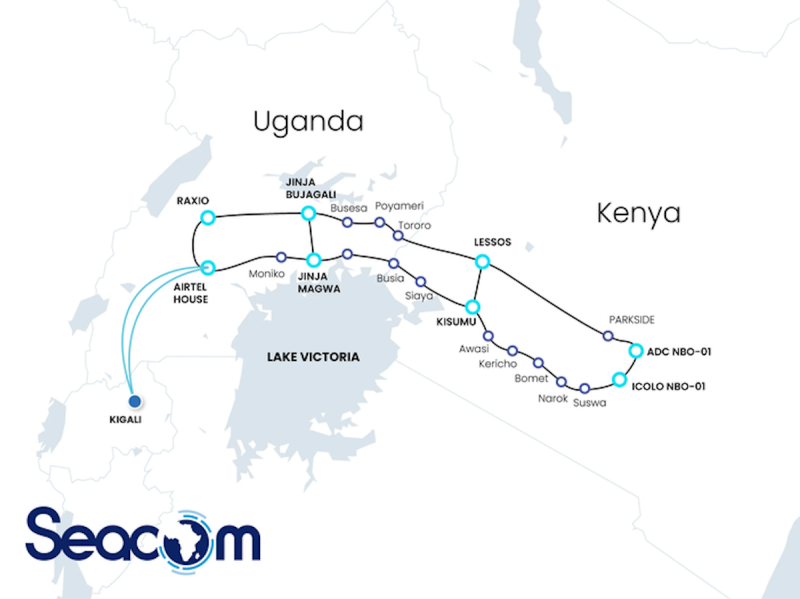
ICT provider Seacom says it has launched a new high-capacity terrestrial network route between Nairobi and Kampala, reinforcing one of East Africa’s most critical digital corridors.
The new route connects key infrastructure hubs in Nairobi, Kisumu and Kampala, creating a more resilient and scalable pathway for traffic moving inland from subsea cable landing stations in Mombasa. It effectively upgrades a long-established corridor into a modern, high-capacity backbone designed to support growing demand for data across East Africa.
Seacom says the Nairobi–Kampala corridor underpins a wide range of industries, from telecommunications and financial services to cloud platforms and digital commerce. As these sectors expand, demand for consistent, low-latency connectivity continues to rise.
The new route is designed to meet that demand by improving access to international bandwidth and enabling faster, more reliable data movement between markets.
Beyond Kenya and Uganda, the route also strengthens regional integration. It provides a more efficient pathway into neighbouring markets such as Rwanda, Burundi and South Sudan, supporting cross-border digital services and regional trade.
Seacom says it has implemented automated switched optical network (ASON) technology, allowing traffic to be rerouted automatically in under 50 milliseconds if a fault occurs. This ensures continuity of service even in the event of multiple network disruptions.
In addition to the traditional A104 corridor, a section of the Trans-African Highway Network running from the port of Mombasa, Kenya, through Nairobi, and extending to Uganda, Rwanda, Burundi, South Sudan, and the DRC, Seacom will be using an alternative pathway via Narok, Kericho and Kisumu. This dual-route approach reduces dependence on a single path and strengthens overall network resilience.
A further differentiator is the use of two border crossings, Malaba and Busia, instead of one. This reduces the risk of a single point of failure and improves network stability for customers operating across borders.
The Nairobi–Kampala route has been built with future demand in mind. At launch, the network activates 1Tbps of capacity, with the ability to scale up to 30 Tbps as demand grows. This allows Seacom to expand capacity quickly without requiring major redesigns or additional infrastructure builds.
Seacom adds that this new route forms part of its broader investment in East Africa’s digital infrastructure.
More Articles you may be Interested in...



Somalia works towards IPv6 transition

NTT Data expands Salesforce offering in Kenya


Nigeria misses target for domain name adoption









IQSTEL plans to acquire 51% of Ghana’s Ultranet