Honor and Valeo announce new facilities in Egypt
Apr 22, 2026


The launch of a sovereign AI ecosystem in Malaysia that allegedly uses Huawei GPU chips took another twist on Wednesday when the Ministry of Investment, Trade and Industry (MITI) issued a statement clarifying that the initiative is not a government project, and that Malaysia is compliant with export control laws governing chipsets.
The "Strategic Artificial Intelligence Infrastructure" project was launched on Monday, featuring a generative AI cloud environment run by Skyvast Cloud. In a speech delivered at the launch event and reported by the official Bernama news agency, Deputy Minister of Communications Teo Nie Ching said the initial AI cloud was powered by eight Huawei Ascend GPUs, and touted the establishment of localised, sovereign AI infrastructure as a major step in Malaysia’s AI development.
Skyvast and Chinese tech firm Leadyo also revealed plans to deploy 3,000 GPUs across multiple infrastructure zones by 2026.
However, on Tuesday, Bloomberg reported that the communications ministry withdrew Teo’s remarks with no explanation. The report noted that the withdrawal came shortly after the US government’s AI and crypto czar David Sacks posted on social media site X that the launch was proof that China was gaining ground in the global AI race, which the US government is actively trying to counter amid the broader trade dispute between the two countries.
On Wednesday, MITI issued a statement further distancing the Malaysian government from the AI cloud project, saying that the Skyvast initiative “was not developed, endorsed, or coordinated by the Government of Malaysia, nor does it form part of any Government-to-Government agreement or nationally mandated technology programme.”
MITI added that while the current Malaysian government “is keen on building up its Al-powered infrastructure to enhance the public sector capacity and services, any such initiative would need to go through the appropriate level of legal, operational, and reputational processes and due diligence that are required for a project of such significance.”
The ministry further stated that Malaysia “remains committed to full compliance with all applicable export control laws, national security directives, and emerging guidance from global regulatory authorities.”
The heart of the controversy stems from last week’s guidance from the US Commerce Department that usage of Huawei's Ascend AI chips "anywhere in the world" violates US export controls. The Commerce Department later changed the wording, saying the guidance “alerts industry to the risks of using PRC advanced-computing ICs, including specific Huawei Ascend chips”.
A Huawei representative told Bloomberg that the company hasn’t sold Ascend chips in Malaysia and that the government hasn’t bought any.
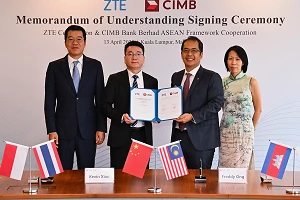
However, last month Huawei Malaysia did sign an MoU with Skyvast to jointly promote Malaysia’s “sovereign AI cloud infrastructure” using Ascend GPUs, as well as Huawei’s Kunpeng servers, cloud platforms and networking solutions.
Ironically, that MoU was announced in a press release issued by Malaysia’s Ministry of Digital as one of six MoUs involving Chinese organisations (four of them with Huawei Malaysia) covering AI, cloud computing and next-generation digital infrastructure. The release specifically mentions Ascend GPUs as part of the Skyvast-Huawei MoU.
That said, the Ministry of Digital release was issued a month before the US Commerce Department’s updated guidance on Huawei’s Ascend chips. It remains unclear if Skyvast is proceeding with the sovereign AI cloud infrastructure with non-Huawei chipsets.
Meanwhile, Malaysia’s move to distance itself from the Skyvast project is happening as the country finds itself caught between the ongoing trade war between the US and China, particularly in relation to chipsets, as well as being involved in its own trade dispute with the US regarding President Donald Trump’s tariff policies.
Last year, Prime Minister Anwar Ibrahim laid out a ten-year multibillion-dollar plan to boost Malaysia’s status as an AI chipset design and manufacturing hub to capitalise on companies seeking cover from the US-China chipset rivalry.
But according to a report in the New York Times on Wednesday, President Trump’s on-again-off-again tariff policies have thrown Malaysia’s chipset ambitions for a loop. Last month, the Trump administration imposed a 24% tariff on all US exports from Malaysia, which has since been temporarily reduced to 10% as the two countries negotiate a solution. But Trump is also considering a blanket levy of at least 25% on all chipset imports on national security grounds, the report said.
According to Reuters, Malaysia exported US$16.2 billion worth of chips to the US in 2024, accounting for almost 20% of all US semiconductor imports.






Company registered in England, number 5724661
All content copyright © 2005-2026 Developing Telecoms Ltd. All rights reserved.